
Carcassonne is a city with a rich history, and with good reason, the 3rd most popular tourist attraction in France. Construction began as early as 1096 and a visit to Carcassonne is equivalent to a trip back to the Middle Ages. Located in the south of France, Carcassonne is known not only for its lively history but also for its impressive fortifications and authentic atmosphere. As you stroll through the cobblestone streets of the old city, surrounded by ancient stone walls, you can taste everywhere the atmosphere of a bygone era. This city is a must visit, during a trip through southern France.
A long history
Carcassonne was originally founded by the Romans and flourished as a strategic and economic center during the medieval period. Its role as an important stronghold was particularly evident during the Albigensian Crusades in the 13th century, where it was of great strategic value as a fortified city.
The impressive city walls, towers and castle testify to the defensive strength the city had to offer. The winding cobbled streets between houses and stores made Carcassonne a bustling center of commerce and culture. The city became a symbol of medieval splendor, in which the Basilica Saint-Nazaire and other architectural masterpieces left their mark on the historical heritage.
After the Middle Ages, Carcassonne experienced a period of decline until the architect Eugène Viollet-le-Ducde took charge of the city in the 19th century. His work preserved Carcassonne’s medieval charm and historical significance, and it was eventually recognized as a UNESCO World Heritage Site. Today, it still feels like walking through that 12th-century city. The car-free downtown makes it even easier to immerse yourself in it.
Carcassonne old town La Cité

Carcassonne today consists of two parts. La Cité, the historic city centre with the castle and the narrow streets within the city walls, where you really immerse yourself in those historic atmospheres. The authentic atmosphere can be felt at every corner, where local artisans sell their wares and traditional markets display the colourful products of the region. The city walls offer panoramic views of the surrounding valleys and the Canal du Midi. This gives an idea of how people used to live and the views they had of any enemy invaders.
Within the walls you will find numerous local restaurants serving typical French cuisine. Of course, the city has adapted to its new status as a tourist attraction, and you do have to work your way through the tourist stores and catering establishments. Still, I found a fine amount of authenticity and local products.
Carcassonne new town
While La Cité is the historical heart of Carcassonne, the new town offers a contemporary atmosphere with cosy squares and local markets. The two parts of Carcassonne are separated by the river Aude. If you cross the historic Pont Vieux bridge you are in the other part. However, construction of the new city also began back in 1245, so it’s not really new. Here you’ll find a more everyday atmosphere, but certainly still plenty of cute little streets and beautiful historical buildings, where again you’ll find plenty of cosy restaurants and cafés.
For a budget trip, I recommend looking for accommodation here, as they are considerably cheaper than in La Cité. It is then about a 20-minute walk from the centre of the new town, to La Cité. I stayed at Le Couvent hostel, an old converted monastery with a cosy atmosphere.
Why Carcassonne is so popular
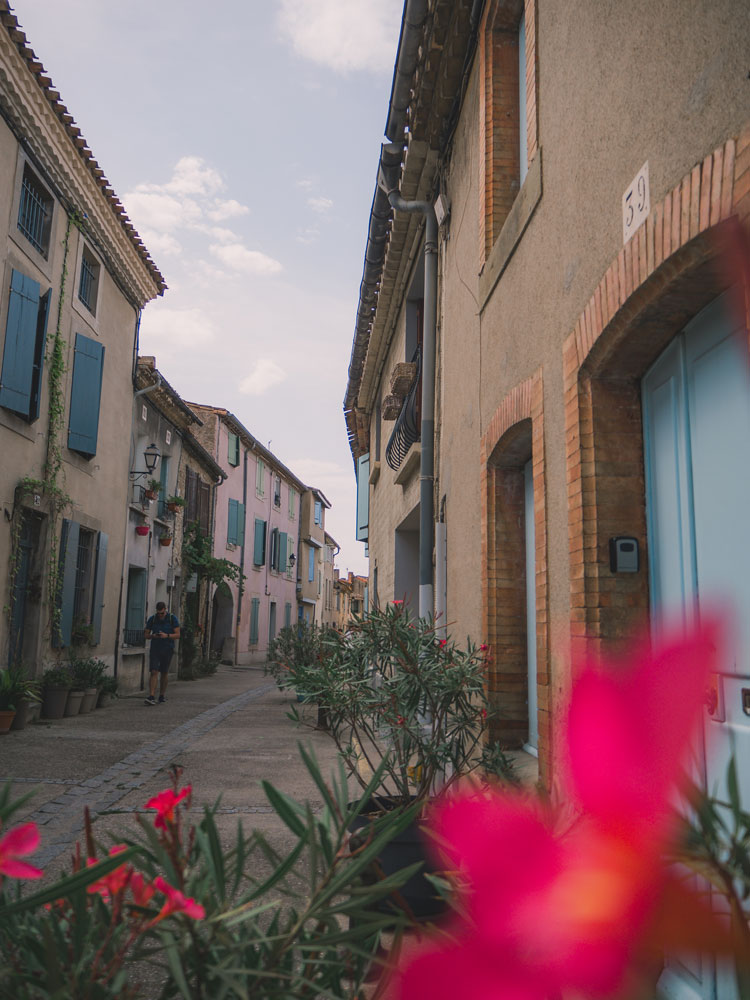
Carcassonne’s appeal lies not only in its history but also in its everyday charm. Whether you are a history buff enjoying the stories behind every stone wall, or just looking for a relaxing afternoon on a local terrace, Carcassonne has something for everyone. The warm southern French sun adds an extra layer to the experience, making the city not only a historical destination, but also a place to enjoy the good life. On the edge of Provence, there is no shortage of fine wines to enjoy a sunny afternoon on a terrace.
The train to Carcassonne
Carcassonne has a train station and is very accessible from major cities in France. There are direct trains to Carcassonne from Lyon, Marseille, Toulouse and Bordeaux. From other cities such as Paris and Nice, you only need to change trains once.
Want to take a train trip through southern France, passing Carcassonne among other places? I have mapped out a nice route from Toulouse, which also takes you through the Pyrenees on the scenic yellow train. You can find it in my southern France travel route guide.





0 Comments